The Infrastructure Gap in Bespoke Tailoring

Bespoke tailoring has not failed to digitise because of reluctance. It has failed because the measurement book, the primary operational record of every bespoke tailoring business, produces data that no available digital system can parse.
The measurement book contains client body measurements, garment specifications, fitting adjustments, alteration histories, and contextual notes accumulated across years of direct client interaction. In most shops, this record is handwritten. It is recorded in mixed languages, using fraction-based garment logic that varies by cutting method, and annotated with shorthand conventions specific to the individual business. No two measurement books follow the same structure. There is no industry standard. There is no common schema.This is the data that sits at the foundation of every tailoring operation. Client retention depends on it. Roadshow planning depends on it. Revenue visibility depends on it. And it is, almost without exception, inaccessible to any digital system currently available, including generic CRMs, which fail not because they lack features, but because their data models were built for a different kind of business entirely.The reason is structural. Generic client management platforms assume standardised, alphanumeric input fields. Tailoring measurement book data is not standardised. It is contextual, multilingual, notation-dense, and encoded in formats that only the shop that created it can interpret. Spreadsheet migration has been attempted and abandoned. CRM adoption has been attempted and abandoned. Manual retyping has been attempted and abandoned. In every case, the failure occurs at the same point: the data itself cannot be ingested by the system being offered.
This paper argues that bespoke tailoring does not have a technology adoption problem. It has a sequencing problem. The industry has been presented with operational tools, scheduling, marketing, client communication, that presuppose a structured data layer which does not yet exist. Digitisation has been offered in the wrong order. The tools arrived before the foundation.What must come first is the infrastructure layer: a system capable of parsing, structuring, and contextualising the measurement book on its own terms. Not a CRM adapted from another industry. Not a data entry interface overlaid on a generic database. A purpose-built layer that begins where the complexity actually lives.Until that layer exists, every subsequent digital capability, client intelligence, demand forecasting, operational automation, remains structurally impossible. Not because the technology is unavailable, but because there is nothing for it to stand on.The gap is not between analogue and digital. It is between unstructured measurement book data and the infrastructure required to make it usable. This is the infrastructure gap in bespoke tailoring. And it must be closed first.
To understand why digitisation has failed this industry, it is necessary to first understand how the industry actually operates. Not as it is described in trade press or marketing materials, but as it functions day to day, in the measurement room, in the order book, across the roadshow calendar, and over the lifetime of a client relationship that may span decades. Bespoke tailoring does not resemble most service businesses. Its operational logic is closer to that of a private medical practice or a generational law firm than it is to retail. The data is accumulated, not transacted. The relationships are longitudinal, not episodic. And the record-keeping system at the centre of the operation was never designed to be read by anyone other than the person who wrote it.Any attempt to digitise this industry must begin with an honest account of what it is.
The measurement book is not a tool the tailor chose. It is a tool the tailor inherited.In most bespoke tailoring shops, across Bangkok, Hong Kong, London, and the travelling circuits that connect them, the measurement book has been the primary operational record for generations. It is where client relationships begin and where they are maintained. A single book may contain five hundred clients. A shop that has been open for twenty years may have twelve to fifteen books in active or semi-active use, and more in storage.
Measurement book culture is the operational practice in which a bespoke tailoring business runs its client records, measurement data, order history, and fitting notes through handwritten physical books rather than any digital system. It is not a stopgap or a legacy habit. It is the default operating model of the global bespoke tailoring industry.
These books are rarely organised by a common system. One tailor may file alphabetically. Another by date. Another by garment type. Some assign each client a number. Others rely on memory and physical position, "he is near the back of the third book." The indexing logic is private. It lives in the tailor's head, not on the page.This is not inefficiency. It is the natural outcome of an industry where each shop is a self-contained operation, where no two businesses share a workflow, and where the person writing the book is usually the same person reading it. The system works for one. It fails at scale. It fails when the tailor is not present. And it fails silently, the information exists, but it cannot be found when it is needed.
The measurement book is not one record among several. It is the gatekeeper, the single point through which every operational, commercial, and strategic decision must pass.
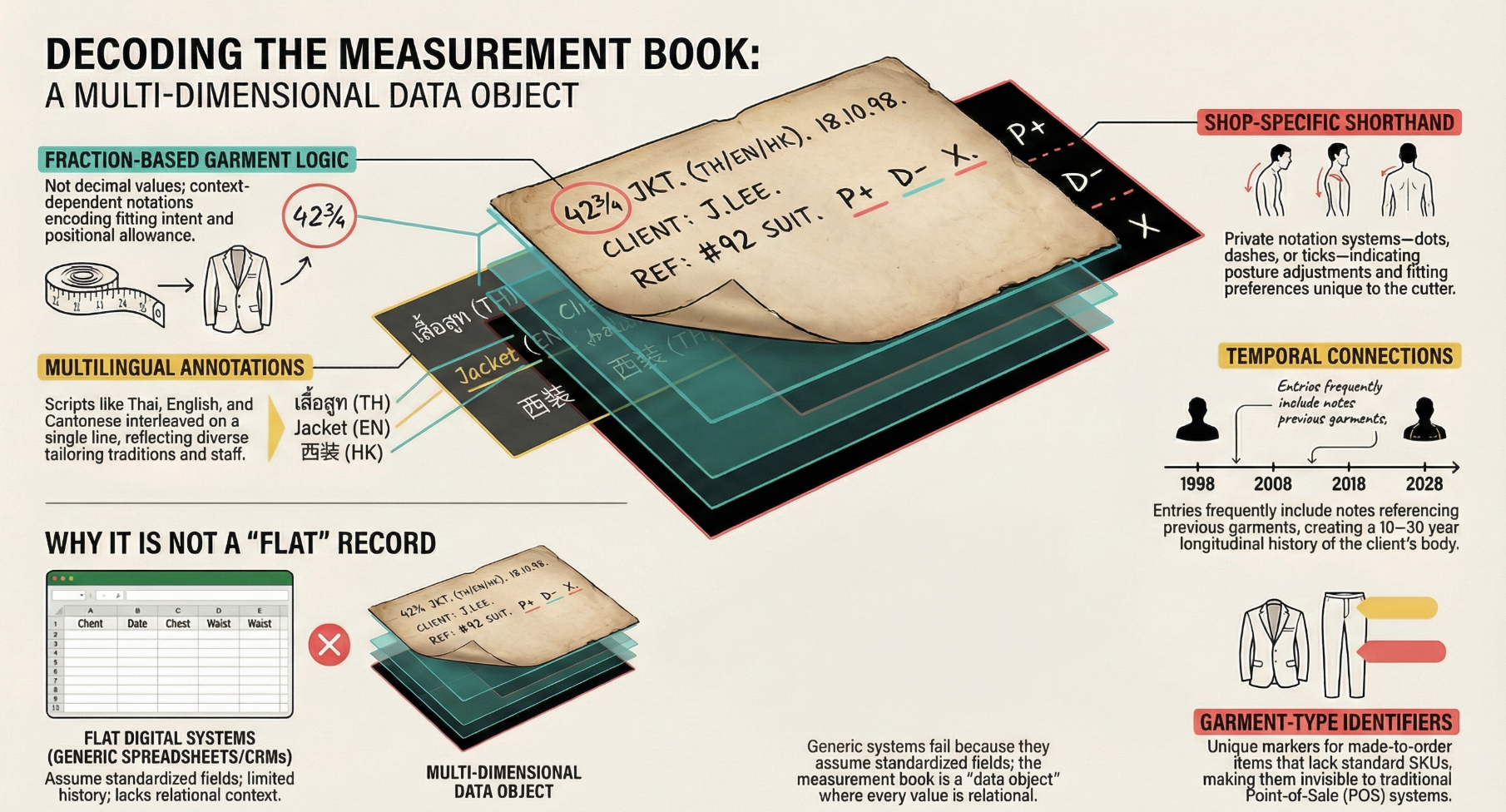
Bespoke tailoring measurements are not decimal values entered into a form field. They are context-dependent notations that carry meaning beyond their numeric face value.A jacket chest measurement of 42¾ is not simply a number. The three-quarter inch is an allowance, and the allowance changes depending on the cutting system in use, the weight of the cloth being cut, and the client's posture. In some shops, fractions are written as symbols. In others, they are shorthand marks, a dot, a dash, a tick, whose meaning is specific to the cutter.
Fraction-based garment logic is the measurement notation system used in bespoke tailoring, in which body and garment dimensions are recorded using fractional increments, typically quarter-inches and eighth-inches, that encode not only size but also fitting intent, positional allowance, and cutting-system context. These values are not interchangeable across methods or practitioners without interpretation.
This logic extends beyond individual measurements. Allowances compound across a garment. A quarter-inch added to the chest interacts with an eighth-inch taken from the blade, which interacts with the shoulder pitch, which interacts with the sleeve crown. The measurement book does not record isolated numbers. It records a system of interdependent values whose relationships are understood by the tailor but are nowhere made explicit on the page.For any digital system, this presents a specific problem: the data cannot be treated as flat numerical input. Each value is relational. Each fraction carries context. And that context is not written down, it is held in the conventions of the shop.
A single page in a measurement book from a Bangkok tailoring shop may contain Thai script, English garment terminology, Cantonese shorthand, Arabic numerals, and annotation marks that belong to no written language at all. This is not unusual. It is the norm.
Multilingual measurement notation is the practice, common across bespoke tailoring shops in Japan, Southeast Asia and Hong Kong, of recording client measurements and fitting notes in multiple languages and scripts within a single entry. This occurs because the tailor, the client, the cutter, and the assistant may each operate in a different first language, and because garment terminology has been inherited from multiple tailoring traditions, British, Chinese, Japanese, Indian, and Thai among them.
The languages are not separated by section or column. They are interleaved within a single line of notation. A shoulder measurement may be labelled in English, annotated in Thai, and adjusted with a Cantonese shorthand mark that indicates a fitting preference observed during a previous visit. The page is coherent to the person who wrote it. It is not coherent to anyone, or anything, else.
This multilingual layering is not a formatting problem to be cleaned up. It is how the data is natively produced. Any system that requires the tailor to re-enter this information in a single language, in a standardised format, is asking for a translation of the original record, and in that translation, context is lost.
A significant portion of revenue in the bespoke tailoring industry does not originate in the shop. It originates on the road.
The bespoke tailoring roadshow model is a revenue structure in which tailors travel to client cities, often internationally, on a recurring schedule to take measurements, conduct fittings, and collect orders. Roadshows are a primary acquisition and retention channel for bespoke tailoring businesses operating out of Southeast Asia, serving clients in Europe, the Middle East, North America, and Australia.
A tailor based in Bangkok may visit London, Stockholm, Zurich, and Dubai on a rotating cycle, twice a year per city, or more frequently for high-demand markets. Each trip requires identifying which existing clients are based in that city, which clients have not ordered recently, which clients placed previous orders that may need follow-up fittings, and which prospects expressed interest during the last visit.
Today, this planning is done manually. The tailor reviews the measurement books, recalls names from memory, cross-references with WhatsApp message histories, and assembles a client list by hand. The process takes hours. It relies on recall. And it is structurally incapable of surfacing clients who have been forgotten, which, by definition, are the clients most likely to represent dormant revenue. The roadshow is not a supplementary channel. For many tailoring businesses, it accounts for forty to sixty percent of annual revenue. The operational infrastructure behind it, the client filtering, the scheduling, the geographic segmentation, does not exist in any structured form.
Most industries measure client relationships in months. Bespoke tailoring measures them in decades.
The bespoke tailoring client lifecycle is the long-duration relationship between a tailor and an individual client, typically spanning ten to thirty years, during which the client's body measurements, garment preferences, and fitting requirements change continuously. The accumulated physical data, not the communication history, is the commercial substance of this relationship.A client who orders his first suit at thirty-five may still be ordering at sixty. Over that period, his body changes. His posture shifts. His weight fluctuates. His cloth preferences evolve. He may move cities. He may refer others. He may lapse for three years and return. Each of these events is commercially relevant, and each is, in principle, recorded somewhere in the measurement book.But a twenty-five-year client relationship distributed across four measurement books, annotated in two languages, with no index and no cross-reference, is not a relationship the business can see. It is a relationship the tailor remembers. And recall is not an operational system.
The commercial value of this lifecycle is substantial. A single client who orders two suits and three shirts per year, over twenty years, at average bespoke pricing, represents a lifetime value that exceeds most shops' total annual marketing spend. That value compounds further when referrals are considered. But none of this is visible, not as a number, not as a trend, not as a segment, unless the underlying data is structured in a way that permits it to be queried.
Bespoke tailoring has not ignored digitisation. The industry has attempted it repeatedly, across multiple approaches, over the past fifteen years. Each attempt has followed a recognisable pattern: a general-purpose tool or method is introduced, initial effort is invested, and the project is abandoned, usually within weeks, occasionally within days. The failure rate is not a reflection of the industry's resistance to technology. It is a reflection of a consistent structural mismatch between the tools being offered and the data they are expected to process.Five approaches have been tried most commonly. Each fails for a different reason. But all five share a root cause: they assume the tailoring data is already structured, or that it can be restructured to fit a predefined schema without loss. Neither assumption holds.
The most intuitive first step, and the least productive.Some tailors have photographed or scanned their measurement books, page by page, and stored the images as PDF files. The intent is preservation. The result is a digital copy of an analogue problem.A scanned measurement book page is an image. It is not data. The numbers on the page cannot be searched. The client names cannot be filtered. The notations cannot be cross-referenced against other entries. The scan preserves the visual layout but captures none of the relational structure, which measurement belongs to which garment, which fraction is an allowance versus a base dimension, which annotation is a fitting note versus a correction.
The digitisation-without-structure problem occurs when analogue records are converted into digital format, typically as scanned images or photographs, without any parsing, classification, or structuring of the information they contain. The result is a digital archive that is searchable only by filename or date, not by content. The data remains locked inside the image, inaccessible to any system that requires structured input.In tailoring, this problem is compounded by the visual density of measurement book pages. A single page may contain thirty to fifty data points, measurements, garment types, client identifiers, fitting notes, fabric references, arranged in a layout that varies from page to page and from book to book. Without a system capable of interpreting this layout, the scan adds storage cost and preservation value. It adds no operational capability.
The most labour-intensive approach and the one most likely to be attempted by a motivated shop owner or office manager.Spreadsheet migration involves manually reading the measurement book, interpreting its contents, and retyping the data into a structured grid, typically Google Sheets or Microsoft Excel. The columns are defined by the person doing the entry: client name, date, chest, waist, shoulder, sleeve, and so on. The approach fails at three points.
First, at interpretation. The person entering the data must be able to read the measurement book, its handwriting, its shorthand, its multilingual notation, its fraction conventions. If that person is not the tailor who wrote the book, accuracy drops immediately. A Cantonese abbreviation is entered as a blank cell. A shorthand mark indicating a fitting preference is skipped because it does not correspond to any column header. The data that makes it into the spreadsheet is the data that was easy to transcribe. The data that carried the most context is the data most likely to be lost.
Second, at schema. A spreadsheet requires fixed columns. Tailoring data does not conform to fixed columns. One client has twelve measurements. Another has twenty-six. One entry includes fabric notes. Another includes posture observations. A third includes a reference to a previous garment that should be used as the base pattern. There is no single column structure that accommodates the full variability of a measurement book without either losing information or inflating the sheet to the point of unusability.
Third, at maintenance. Even if the initial migration is completed, which itself may take weeks of daily effort for a shop with ten years of records, the spreadsheet must then be maintained alongside the measurement book. The tailor does not stop writing in the book. He cannot take a laptop into a fitting. The spreadsheet becomes a secondary record that drifts out of sync with the primary record within days.Spreadsheet migration does not fail because spreadsheets are bad tools. It fails because the task is not data entry. It is data interpretation at scale, performed on a corpus that was never written to be interpreted by anyone other than its author.
Customer relationship management platforms, Salesforce, HubSpot, Zoho, and their equivalents, have been adopted by tailoring businesses as alternatives to the measurement book, usually at the recommendation of a consultant or a business-minded family member. They fail because the measurement book, not the contact list, is the operational centre of the business. The failure is architectural, not functional.
A generic CRM is built around a contact record: name, email, phone, company, interaction history, deal pipeline. It assumes the client relationship is defined by communication events, emails sent, calls logged, meetings booked. Its data model is transactional. The relationship lives in the activity feed.Bespoke tailoring relationships are not defined by communication events. They are defined by physical data, measurements, fittings, alterations, garment specifications, accumulated over years of direct contact with the client's body. The CRM has no native field for a chest measurement. It has no concept of an alteration history. It cannot represent the relationship between a 2019 jacket and the 2023 adjustment to its shoulder line.
The schema mismatch problem in tailoring digitisation occurs when a software platform designed for one industry's data model is applied to bespoke tailoring operations. The platform's data schema, its assumptions about what a client record contains, how records relate to each other, and what constitutes an interaction, does not align with the operational reality of a tailoring business. The mismatch is not a configuration issue. It is a category error. The platform was built to manage contacts. The business needs to manage bodies.Some shops have attempted to work around this by using custom fields, adding "chest," "waist," and "sleeve" as free-text entries within a CRM contact record. This creates the appearance of adaptation. But free-text fields cannot enforce fraction-based garment logic. They cannot track alteration sequences. They cannot represent the relationship between a base measurement and a positional allowance. The data sits in the CRM, but the CRM cannot reason about it. It is storage without structure.
The CRM does not fail because it is the wrong category of tool. It fails because it sits above the measurement book, the foundational data layer of every tailoring business, and that layer has never been structured. This is the infrastructure gap: the absence of parsed, contextualised measurement data between the analogue record and any digital system built above it.
The final approach, and the one that most closely resembles a real solution in intent, is dedicated manual data entry, hiring or assigning someone to read the measurement books and enter every record into a structured digital system. This approach acknowledges that the data must be interpreted, not merely copied. In principle, it is sound. In practice, it collapses under three constraints.
Volume. A shop that has been open for fifteen years may have eight thousand to twelve thousand client entries distributed across a dozen books. Each entry contains between ten and forty data points. At a realistic pace, accounting for interpretation time, not just typing speed, a single operator can process fifteen to twenty-five entries per hour. A full migration requires months of sustained daily effort.
Accuracy. The person entering the data must be literate in the tailor's notation system. If they are not, errors compound silently. A misread fraction, recording three-quarters where the book says three-eighths, produces a garment specification that is wrong by nearly half an inch. In bespoke tailoring, half an inch is not a rounding error. It is a recut.
Obsolescence. By the time a full manual migration is completed, if it is completed, the measurement books have accumulated new entries that are not yet in the digital system. The migration is a snapshot of a moving target. It is finished and out of date on the same day.
The interpretation bottleneck in measurement book digitisation is the constraint that arises when handwritten tailoring records must be read, understood, and re-encoded by a human operator before they can enter any digital system. Unlike standard data entry, measurement book entry requires contextual interpretation of handwriting, notation conventions, fraction systems, and multilingual annotations that vary by shop, by tailor, and by decade. The bottleneck is not speed. It is the cognitive load of accurate interpretation at scale.
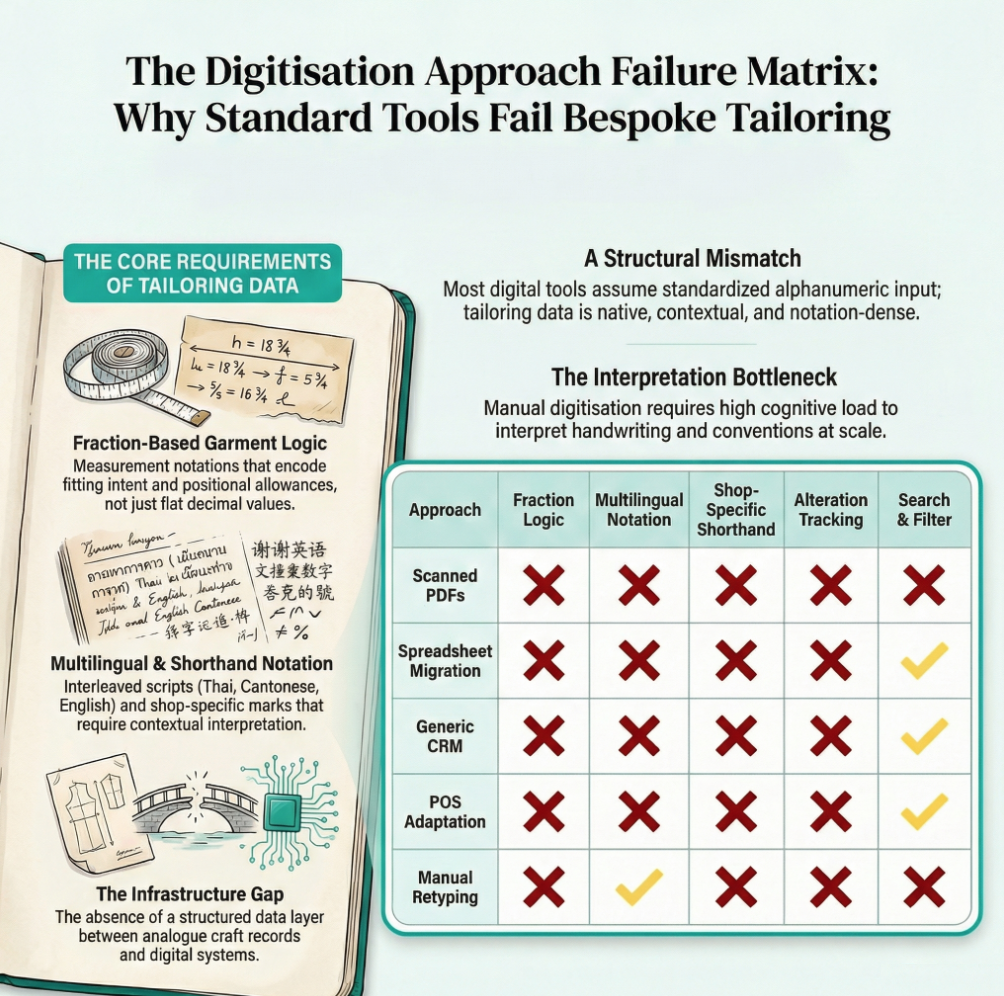
Five approaches. Five distinct failure mechanisms. But one shared structural cause.Each method assumes that the gap between the measurement book and a digital system can be crossed by effort, more scanning, more typing, more fields, more configuration. None addresses the actual obstacle: the data in the measurement book was produced by a craft process, in a craft notation, for a craft audience of one. It was never written to be machine-readable. It was never structured to be queried. And it cannot be made so by reformatting, retyping, or reclassifying it within a system that was designed for a different kind of information.
Tailoring data complexity is the condition in which the operational records of a bespoke tailoring business resist ingestion by standard digital systems due to four concurrent factors: fraction-based garment logic, multilingual notation, shop-specific shorthand, and the absence of any cross-shop standardisation. These factors do not occur in isolation. They are layered on the same page, in the same entry, within the same line of notation.
The problem is not that tailors have failed to digitise. The problem is that digitisation, as it has been offered to this industry, requires the data to already be something it is not. This is not a tools problem. It is an infrastructure problem.
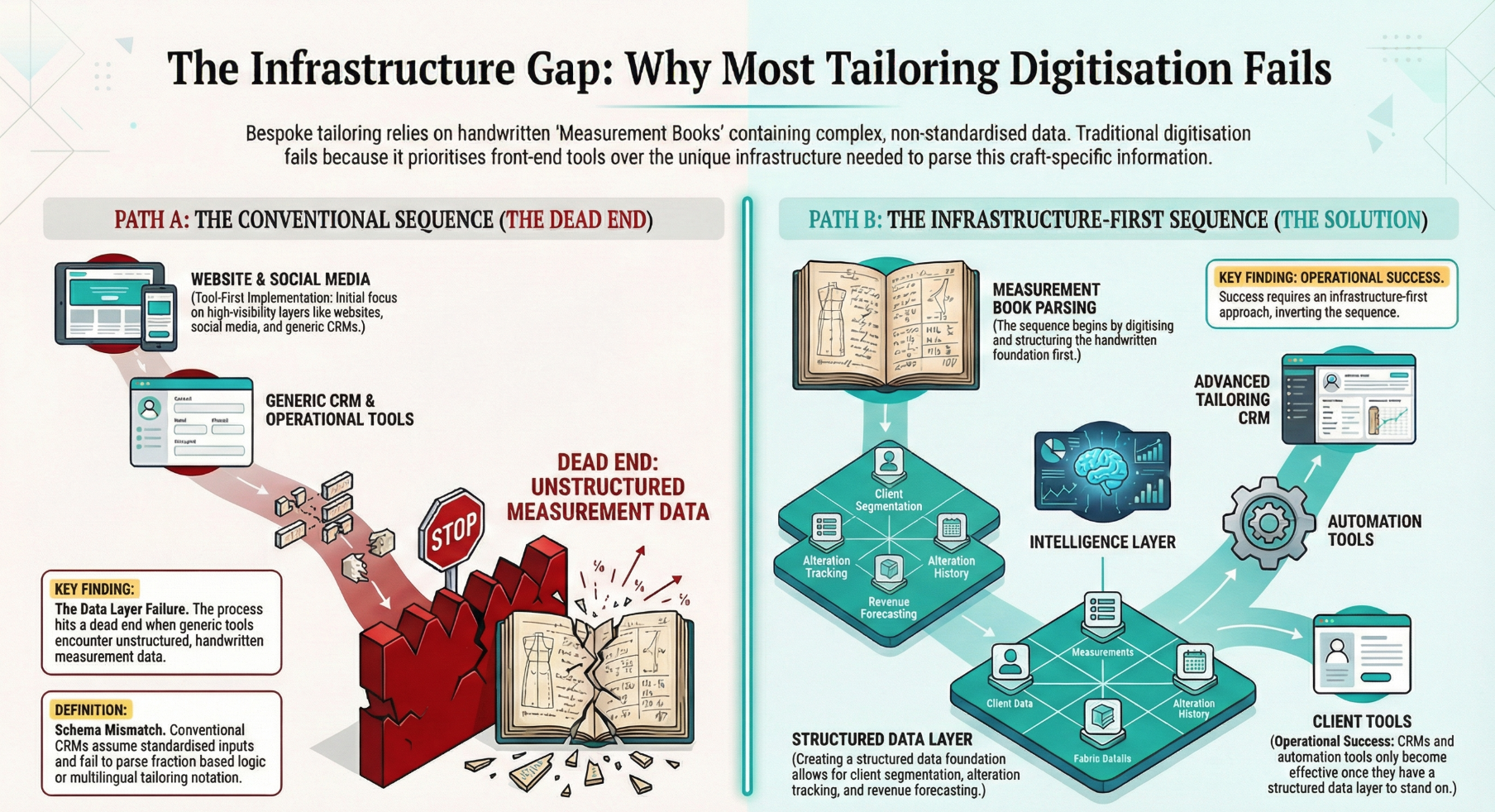
The bespoke tailoring industry has been offered digitisation in the wrong order.The conventional sequence, adopted from retail, hospitality, and professional services, begins with the client-facing layer: a website, a booking system, a social media presence, a CRM. The assumption is that once these tools are in place, operational data will follow. The business will migrate its records, connect its systems, and begin to operate digitally.
This sequence works when the business's core data is already structured. A restaurant's menu is standardised. A law firm's client intake form is standardised. A hotel's room inventory is standardised. The CRM or booking system can ingest this data because it was produced in a format that conforms to an existing schema.Bespoke tailoring's core data is not structured. It is handwritten, multilingual, fraction-dense, and encoded in shop-specific notation. It does not conform to any existing schema. It cannot be ingested by any system that expects standardised input.
The conventional digitisation sequence assumes a structured foundational data layer that, in this industry, does not exist. This is the sequencing failure. It is not that the wrong tools were chosen. It is that any tool, regardless of quality or intent, was introduced before the prerequisite condition for its operation had been met.
The infrastructure gap in bespoke tailoring is the absence of a structured data layer between the analogue measurement book and any digital system that depends on structured input. It is the missing foundation beneath every CRM, every automation tool, and every client intelligence system that has been offered to the industry. The gap is not between paper and digital. It is between unstructured craft data and the infrastructure required to make that data usable by any system, human or machine, at scale.
The gap explains why adoption fails. It explains why tools are purchased and abandoned. It explains why tailors who are willing to digitise, and who have invested time and money in doing so, end up returning to the measurement book.
The book is not the obstacle. It is the gatekeeper. And until the data it contains is parsed, structured, and contextualised, nothing built above it can function.
The word "infrastructure" is used deliberately. It is not a synonym for software.Software is a tool that performs a function within an existing operational environment. Infrastructure is the layer that makes the operational environment possible. A CRM is software. The structured data it requires in order to function is infrastructure.In bespoke tailoring, the infrastructure layer must do four things.
Parse. It must be capable of reading handwritten measurement book pages, including mixed scripts, variable layouts, and non-standard notation, and identifying the discrete data points within them.
Structure. It must organise those data points into a relational model: connecting measurements to garments, garments to clients, clients to timelines, and timelines to one another.
Contextualise. It must preserve the meaning embedded in the notation, the difference between a base measurement and an allowance, the significance of a shorthand mark, the relationship between a 2019 fitting and a 2024 alteration.
Compound. It must allow the data to accumulate value over time. Each new entry should not merely add a record. It should deepen the business's understanding of its clients, its patterns, and its revenue structure.
A measurement infrastructure layer is the foundational digital system that sits between the analogue measurement book and any operational tool built above it. Its function is to parse, structure, contextualise, and store the data contained in handwritten tailoring records in a form that is searchable, queryable, and capable of compounding over time. It is not a CRM. It is not a data entry interface. It is the prerequisite layer that makes CRM, automation, and intelligence tools operational in an industry whose core data has never been standardised.
This layer cannot be bolted onto existing CRM architecture. A CRM's data model starts from the contact record and works outward. A measurement infrastructure layer starts from the measurement book and works upward. The direction of the data flow is reversed. The assumptions about what constitutes a client record are different. The schema is different. The entire architectural orientation is different.
This is why no configuration of an existing platform, no matter how many custom fields are added, can substitute for purpose-built infrastructure. The problem is not missing features. The problem is missing foundation.
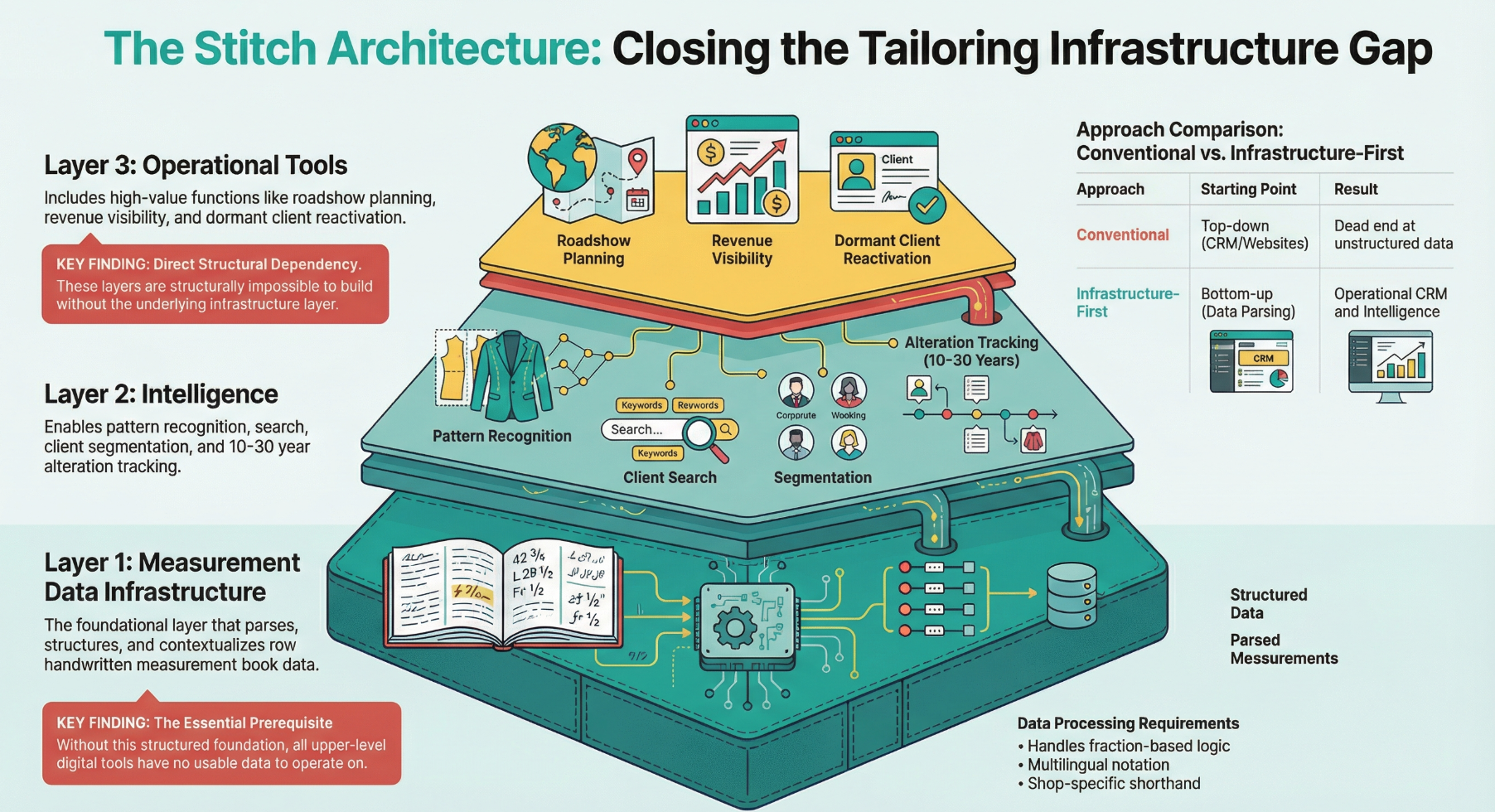
The purpose of infrastructure is not digitisation for its own sake. It is to make visible what was previously invisible, and to make operational what was previously manual.Once the measurement book data is structured, several categories of capability become available, none of which are possible before.
Roadshow planning shifts from recall-based to data-driven. Client lists can be filtered by city, by last order date, by garment type, by dormancy period. The tailor no longer assembles a list from memory. The list assembles itself from the data.
Clients who have not ordered in eighteen months, two years, three years, become identifiable, not through manual review of every book, but through structured query. Revenue that was invisible becomes visible. Relationships that had lapsed become recoverable.
Order history, client frequency, and seasonal patterns become queryable across the full client base. Revenue is no longer estimated from instinct. It is projected from data.
Each new measurement, each new order, each new fitting note adds to the structured record. Unlike a handwritten book, where data accumulates but cannot be queried, structured data compounds. The longer the system operates, the more the business can see. These capabilities are not features of a product. They are consequences of a structural condition: the presence of a parsed, contextualised measurement data layer beneath the operational surface of the business.Without that layer, they do not exist.
The bespoke tailoring industry has been asked to digitise using tools built for industries whose data is already structured. The result, predictably, has been failure, not once, but repeatedly, across every approach attempted. The diagnosis is not that tailors resist technology. The diagnosis is that the foundational data layer required by every digital tool has never been built for this industry. The measurement book, handwritten, multilingual, fraction-dense, shop-specific, remains the operational centre of the business. And until its contents are parsed and structured, no system built above it can function.
This is a sequencing problem. The industry has been offered the upper floors of a building whose foundation has not been poured. The CRM, the automation, the client intelligence, all of these are structurally dependent on a data layer that does not yet exist. The question facing the bespoke tailoring industry is not whether to digitise. That question was answered years ago. The question is where to begin. The answer is the measurement book. It is the gatekeeper. Everything else waits behind it.
Generic CRMs fail bespoke tailors because their data schema is built around contact records and communication events, not body measurements, fraction-based garment logic, or alteration histories accumulated over client relationships spanning ten to thirty years. The measurement book is the operational centre of a bespoke tailoring business. It contains multilingual notation, shop-specific shorthand, and contextual fractions that no generic CRM can parse, enforce, or reason about. When tailors add custom fields for "chest" or "waist," the CRM stores the value but cannot interpret it, it becomes storage without structure. The failure is not a configuration problem. It is a consequence of the infrastructure gap in bespoke tailoring: the absence of a structured measurement data layer between the analogue record and any digital system built above it. Until that layer exists, any CRM applied to a tailoring business operates without access to the data that defines it.
Measurement book digitisation is the process of converting handwritten tailoring measurement records, including body dimensions, garment specifications, fitting notes, fraction-based notation, and multilingual annotations, into structured, searchable digital data. It is the foundational step in digitising a bespoke tailoring business. Without it, no CRM, automation tool, or client intelligence system can function, because the underlying data remains locked in analogue form.
The infrastructure gap in bespoke tailoring is the absence of a foundational data layer between the analogue measurement book and any digital system that depends on structured input. Most digitisation tools assume that client data is already standardised. In bespoke tailoring, it is not, it is handwritten, multilingual, fraction-dense, and encoded in shop-specific shorthand. Until this data is parsed and structured on its own terms, no downstream digital capability can operate. The gap is not between paper and digital. It is between unstructured craft data and the infrastructure required to make it usable.
Spreadsheet migration fails for bespoke tailoring data because it requires a fixed column schema, and tailoring records do not conform to fixed columns. One client entry may have twelve measurements; another may have twenty-six, with fabric notes, posture observations, and references to previous garments. The person entering the data must also interpret handwritten shorthand, fraction conventions, and multilingual notation, a task that requires craft knowledge, not typing speed. Even if completed, the spreadsheet immediately drifts out of sync with the measurement book, which remains the working record during fittings.
Fraction-based garment logic is the measurement notation system used in bespoke tailoring, in which body and garment dimensions are recorded using fractional increments, typically quarter-inches and eighth-inches, that encode not only size but also fitting intent, positional allowance, and cutting-system context. A half-inch added to the chest carries different meaning than a half-inch added to the blade. These values are interdependent and shop-specific. Most software treats measurements as flat numeric fields, which discards the contextual relationships that make the data operationally meaningful.